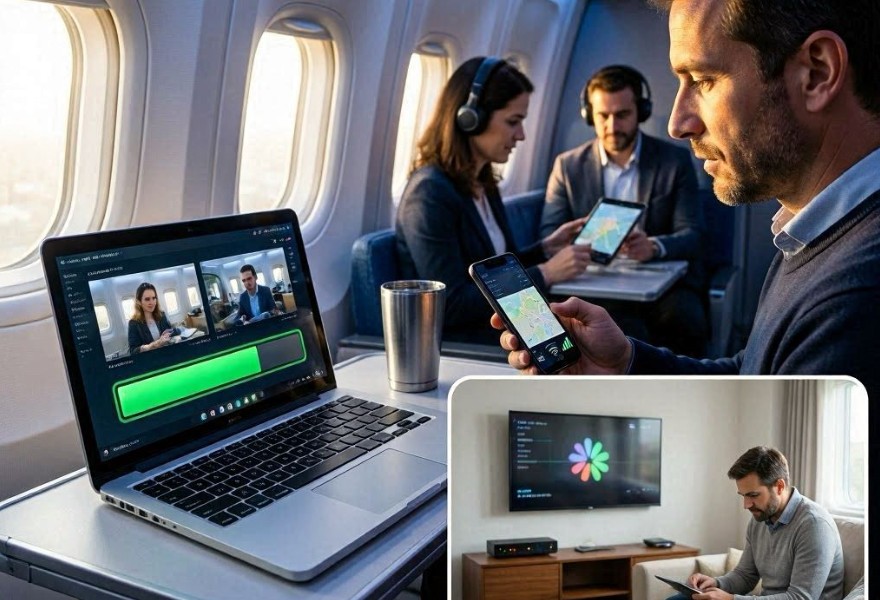
For over a decade, inflight WiFi has been the subject of countless jokes among frequent flyers. Passengers paid exorbitant fees only to experience speeds reminiscent of the dial-up internet era. Loading a simple text email felt like a victory, while streaming video or joining a live Zoom meeting was completely out of the question. The sky was notoriously known as the last remaining dead zone for high-speed digital connectivity.
However, a quiet technological revolution is taking place at 35,000 feet. Thanks to a massive shift in satellite infrastructure, next-generation internet tech, and intense competition among global airlines, inflight WiFi is undergoing a dramatic transformation. In fact, on many modern aircraft, the internet speeds available to passengers are not just catching up—they are becoming significantly faster, more reliable, and lower in latency than the average home broadband connection.
The Technology Shift: From Ground Towers to Low-Earth Orbit
To understand why airplane internet used to be so poor, and why it is suddenly skyrocketing in performance, we have to look at the underlying technology that connects a speeding aluminum tube to the World Wide Web.
The Limitations of Air-to-Ground (ATG) Systems
Early iterations of inflight connectivity relied heavily on Air-to-Ground (ATG) systems. These systems used antennas mounted on the belly of the airplane to pick up signals from cell towers on the ground. While ATG was a step forward, it suffered from severe limitations. Total bandwidth was shared among all connected aircraft within a tower's range, meaning speeds rarely exceeded a meager 10 Mbps per plane. Furthermore, ATG networks completely stopped working when flying over large bodies of water or remote, unpopulated regions.
The Rise of LEO Satellite Constellations
The real game-changer has been the transition to satellite internet, specifically Low-Earth Orbit (LEO) constellations. Unlike traditional Geostationary (GEO) satellites that sit 35,000 kilometers away from Earth, LEO satellites orbit just a few hundred kilometers above us.

- Ultra-Low Latency: Because the physical distance the data must travel is drastically reduced, latency drops from a sluggish 600+ milliseconds down to a crisp 30–50 milliseconds. This mimics the instantaneous responsiveness of a home fiber-optic connection.
- Unprecedented Bandwidth: Providers like SpaceX’s Starlink Aviation use massive fleets of interconnected satellites to beam high-capacity Ka-band and Ku-band signals directly to electronically steered antennas on top of the airplane. This delivers up to 350 Mbps of dedicated bandwidth directly to a single aircraft.
What This Means for the Modern Passenger
This massive influx of bandwidth is completely rewriting the rules of what passengers can achieve while traveling. Airplanes are no longer places where productivity goes to die; instead, they are becoming fully functional sky offices and high-tech entertainment hubs.
Seamless Cloud Workspace and Gaming
With speeds exceeding 100 Mbps per user and low latency, business travelers can effortlessly download massive enterprise files, manipulate live databases, and host high-definition video conferences without a single hiccup. For leisure travelers, this level of connectivity opens the door to cloud gaming platforms and lag-free streaming of 4K content on personal devices simultaneously.
The Death of the Paywall: Free WiFi for All
Historically, airlines charged premium rates for data access to limit the number of users and prevent the network from crashing. Now, because the new satellite networks can easily handle hundreds of devices streaming at the same time, major carriers are ditching the paywall entirely. Airlines are increasingly offering high-speed WiFi completely free of charge to all passengers as a standard perk of their ticket, turning internet access into a competitive battleground.

Challenges on the Horizon: Bandwidth Congestion
Despite these incredible advancements, maintaining speeds that outpace home internet over the long term presents unique engineering challenges. As more airlines adopt these high-speed networks and every single passenger connects multiple devices, overall data consumption will skyrocket. Ensuring that speeds do not degrade over congested flight corridors—such as the busy skies over New York, London, or Tokyo—will require continuous satellite launches and constant software optimization from tech providers.
Conclusion
The era of frustrating, slow, and expensive inflight internet is officially coming to an end. The integration of Low-Earth Orbit satellite constellations has turned commercial airplanes into some of the fastest-connected moving spaces on the planet. For modern independent travelers and business professionals, this means the boundary between life on the ground and life in the air has completely evaporated. The next time you step onto a modern aircraft, you can confidently leave your offline downloads behind; the sky is now faster than home.
