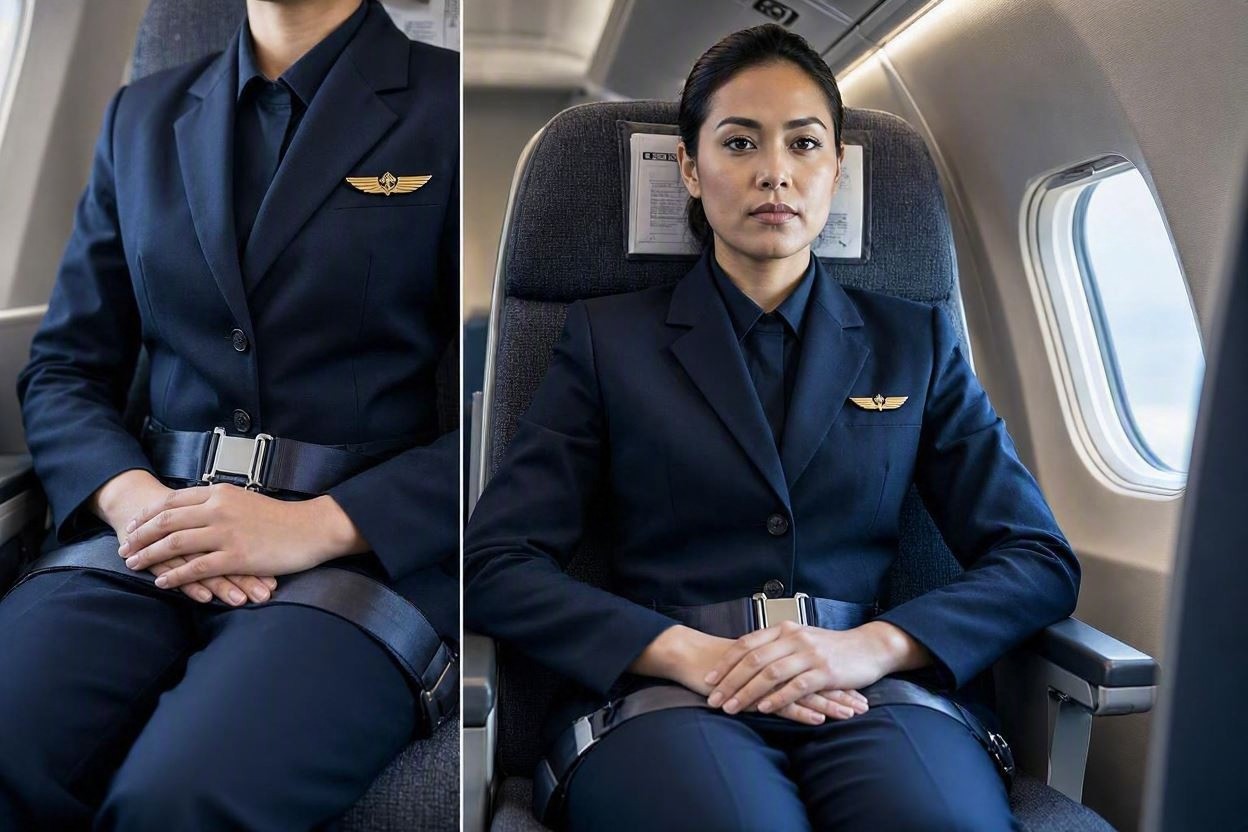
If you have ever watched cabin crew during takeoff or landing, you may have noticed a curious detail: flight attendants often appear to sit on their hands. It can look unusual, even uncomfortable, but it is not a habit, a superstition, or a way to hide nerves. It is part of a carefully trained safety position designed to protect the crew during the most critical phases of flight.
Flight attendants are not only service professionals. They are trained safety specialists, and their jump seat posture is chosen for a practical reason: if something goes wrong, they must be physically able to react immediately. Protecting their hands, arms, posture, and concentration helps them do exactly that.
The Simple Reason: It Is a Brace Position
The main reason flight attendants sit on their hands is to assume a brace position. During takeoff and landing, the aircraft is closer to the ground, traveling fast, and operating in phases where abnormal events require rapid response. A secure posture reduces the risk of injury if there is sudden braking, a hard landing, turbulence, or an impact.
Depending on the airline, aircraft, and jump seat direction, the exact position may vary. However, many cabin crew members are trained to sit upright with their back and head against the seat, feet firmly placed, harness tightened, elbows tucked, and hands placed under the thighs or held securely on the lap.
Why the Hands Matter
Hands are essential tools in an emergency. Flight attendants may need them to release harnesses, open aircraft doors, operate emergency slides, use firefighting equipment, give commands, assist passengers, or handle medical situations. If their hands or wrists are injured during an unexpected event, the evacuation process could be delayed.
By keeping the hands under the thighs or secured close to the body, crew members reduce the chance that their arms will flail forward or hit nearby equipment. This protects the fingers, wrists, elbows, and shoulders from preventable injuries.
It Helps Keep the Body Stable
Aircraft jump seats are compact, and cabin crew are often seated near galleys, doors, or emergency equipment. In a sudden stop or impact, loose arms can move violently. A controlled arm position keeps the upper body more stable and aligned with the seat and restraint system.
This is especially important because flight attendant jump seats may face forward, backward, or sideways depending on the aircraft layout. A stable brace position helps the body absorb force more safely, regardless of seat orientation.
Reducing Reflex Movements
In a sudden event, the natural human reaction is to reach out and grab something. That instinct can cause broken fingers, sprained wrists, or shoulder injuries. Sitting on the hands helps prevent this reflex. Instead of throwing the arms forward, the crew member stays compact and protected.
This is similar to why passengers are sometimes instructed to adopt a brace position that keeps the head and arms protected. The exact passenger position may differ, but the principle is the same: reduce uncontrolled movement and protect the body from impact.
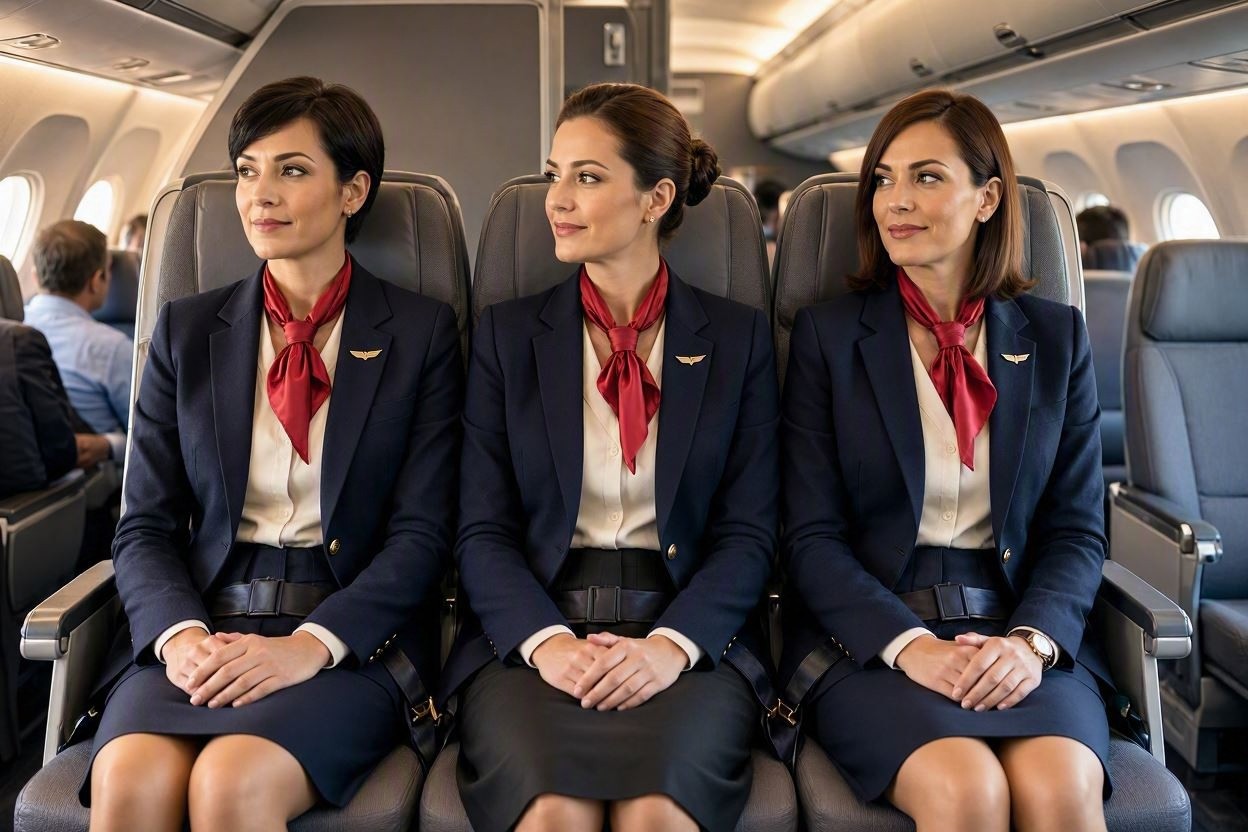
Takeoff and Landing Are Critical Phases
Cabin crew usually adopt this posture during takeoff and landing because these are known as critical phases of flight. Most flights are routine, and serious incidents are rare, but aviation safety depends on preparation for unlikely events.
- Takeoff involves high speed, rapid acceleration, and a limited time window for stopping.
- Landing involves approach, touchdown, deceleration, and potential runway hazards.
- Low altitude gives the crew less time to respond if an emergency occurs.
- Passengers, doors, exits, and cabin equipment must be monitored closely.
For this reason, cabin crew are seated, strapped in, and mentally focused during these moments. The visible hand position is only one part of a larger safety routine.
The Silent Review
While seated on the jump seat, flight attendants are often performing what is known as a silent review. This is a mental checklist that prepares them for immediate action. They may review door operation, emergency commands, evacuation routes, outside conditions, nearby passengers who might need help, and the location of safety equipment.
To passengers, the crew may appear still and quiet. In reality, they are alert, listening, observing, and preparing for several possible scenarios. Sitting in a secure position supports that focus because it removes unnecessary movement and keeps the body ready.
Is It the Same on Every Airline?
No. Procedures differ between airlines and aviation authorities. Some crew members place their hands under their thighs. Others rest them palms down on their thighs, clasp them in their lap, or use another approved position. The key requirement is that the posture must be stable, protective, and consistent with the airline's safety training.
Aircraft design also matters. A rear-facing jump seat may require a slightly different brace technique than a forward-facing one. The location of the jump seat, the type of harness, and nearby cabin structures can influence the approved posture.
It Is Not About Comfort
Many passengers assume the position is uncomfortable, and it can look rigid. But comfort is not the priority during takeoff and landing. The goal is injury prevention and readiness. Cabin crew train repeatedly so the position becomes automatic and can be maintained without distraction.
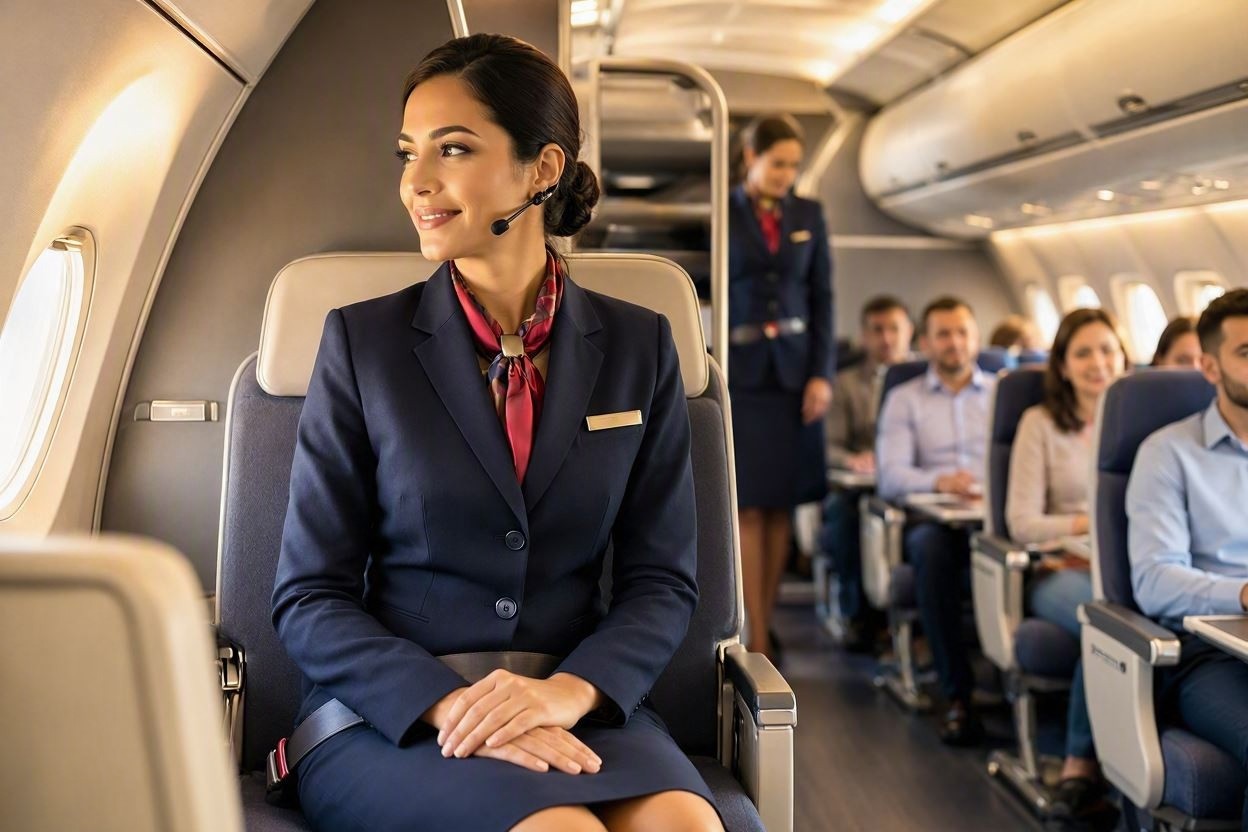
Should Passengers Do the Same?
Passengers should not copy cabin crew posture unless instructed. Passenger brace positions are designed for passenger seats, not jump seats. The correct position depends on seat type, available space, whether there is a seat in front, and instructions from the crew.
If cabin crew give safety commands, passengers should follow them exactly. In an emergency, the crew's instructions are based on training, aircraft layout, and the situation at that moment.
Conclusion
Flight attendants sit on their hands because it is a practical safety measure. The position protects their hands and arms, reduces uncontrolled movement, stabilizes the body, and helps ensure they can respond quickly if an emergency occurs. It is also part of a disciplined routine used during takeoff and landing, when attention and readiness matter most.
What may look like a small detail is actually a sign of professional training. Cabin crew are preparing not for what usually happens, but for what could happen. That preparation is one of the reasons modern air travel remains so safe.
