
The illusion of a single ticket price
To most passengers, airline pricing looks random: the same seat can cost dramatically different amounts depending on when and where you search. In reality, airlines do not sell “one price per seat.” They sell seats through a complex, constantly changing pricing system designed to maximize total revenue per flight.
What you see online is only the final output of a much larger system involving forecasting, segmentation, competition tracking, and automated price optimization.
Revenue management: the core system behind pricing
Airlines use a discipline called revenue management (or yield management). The goal is not to fill every seat cheaply, but to sell each seat at the highest price the market will tolerate.
Every flight is treated as a perishable product with a fixed inventory: once the plane departs, unsold seats lose all value. This creates constant pressure to balance two competing goals:
- Fill the aircraft (load factor optimization)
- Maximize revenue per passenger (yield optimization)
Fare classes: why the same seat has many prices
Each aircraft seat is not sold as a single product. Instead, it is assigned to multiple fare classes, each with its own rules and price level.
How fare classes work
- Economy is split into multiple sub-classes (e.g., deeply discounted, standard, flexible)
- Each class has a limited number of seats allocated
- Lower fares disappear as those “buckets” fill up
- Higher fare classes remain available for last-minute or business travelers
This system allows airlines to sell cheap tickets early while preserving the ability to charge premium prices later.
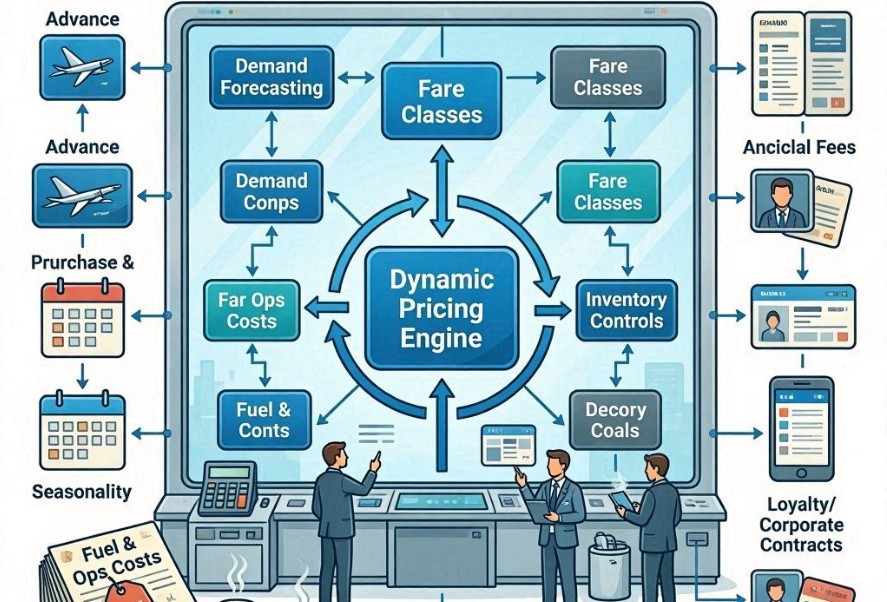
Demand forecasting and probability models
Before a ticket is even sold, airlines run predictive models estimating demand for each flight. These models consider:
- Historical booking patterns on the same route
- Seasonality (holidays, summer peaks, etc.)
- Day of week and time of departure
- Local events and business cycles
The system continuously updates forecasts as new bookings arrive, adjusting price availability in real time.
Dynamic pricing: prices that change every few minutes
Airline prices are not static. They are dynamically adjusted based on supply and demand signals.
If bookings exceed expectations, low fare classes are removed quickly. If demand is weak, discounts may reappear temporarily to stimulate sales.
Key inputs into dynamic pricing
- Remaining seat inventory
- Time until departure
- Competitor pricing on the same route
- Search and booking activity trends
- Macroeconomic and seasonal factors
The “booking curve” effect
Airlines rely heavily on predictable booking behavior over time, known as the booking curve.
Typically, different traveler types book at different times:
- Early bookings: price-sensitive leisure travelers
- Mid-window: mixed demand (business + leisure)
- Late bookings: business travelers with urgent needs
Because late travelers are less price-sensitive, airlines intentionally reserve higher-priced inventory for the final stages before departure.
Competition and real-time market monitoring
Airlines constantly monitor competitor fares using automated systems. If a rival airline drops prices on the same route, pricing engines may respond within minutes.
This creates a highly reactive market where prices fluctuate based on continuous algorithmic negotiation between carriers.
Personalization: does your search history matter?
There is a common belief that airlines increase prices based on your browsing history. In reality, modern airline pricing is generally not individualized at the user level in the way many people assume.
However, prices can appear to change due to:
- Rapid inventory updates (seats being booked by others)
- Cache differences across search platforms
- Different fare class availability shown in real time
The system is driven more by aggregate demand than by individual user profiling.
Ancillary revenue: tickets are only part of the strategy
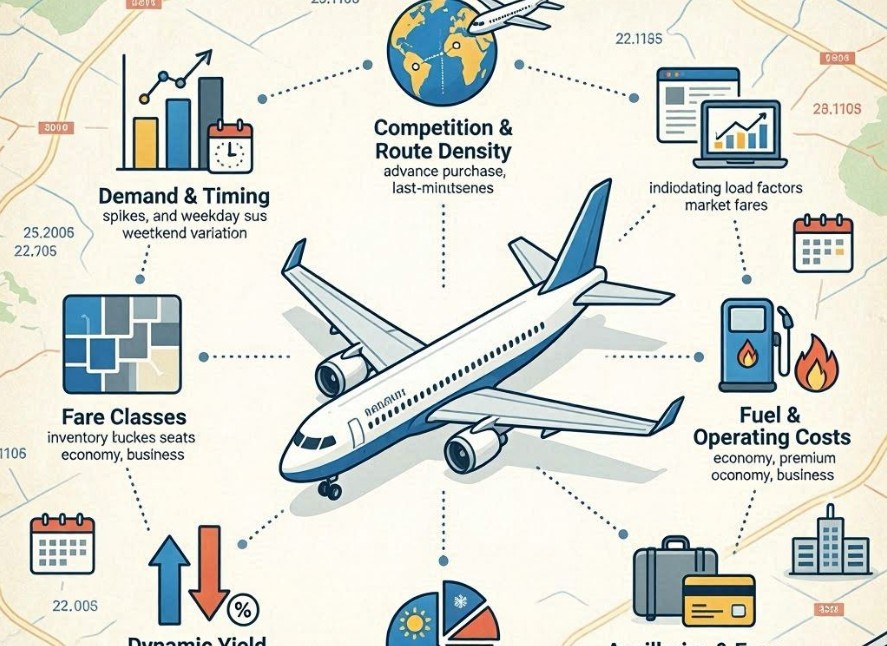
Airlines do not rely solely on ticket prices for profit. A significant portion of revenue comes from add-ons such as:
- Checked baggage fees
- Seat selection charges
- Priority boarding
- In-flight services
This allows base ticket prices to appear lower while total trip revenue increases through optional purchases.
Overbooking: selling more seats than exist
Airlines intentionally sell more tickets than available seats to compensate for no-shows. Statistical models estimate how many passengers are likely not to show up for a flight.
If everyone arrives, airlines manage the surplus through compensation offers or rebooking on later flights.
Why prices rise closer to departure
Last-minute prices are often significantly higher because:
- Most discounted fare classes are already sold
- Remaining inventory is reserved for high-value travelers
- Business travelers are less price-sensitive
- Demand uncertainty is reduced closer to departure
Conclusion: pricing as a continuous optimization system
Airline ticket pricing is not a fixed schedule of fares but a constantly evolving optimization problem. Every seat is part of a dynamic system balancing demand forecasting, competitive behavior, customer segmentation, and time sensitivity.
What appears to passengers as “random price changes” is in fact a highly structured algorithmic process designed to extract maximum value from a limited and perishable inventory.
